

Guides
Starting a business first hundred days: Delaware entity filing costs
Starting a business first hundred days in Delaware: entity filing costs, registered agent, EIN, annual report and franchise tax dates to budget before revenue.
What to take away
- Starting a business first hundred days in Delaware means paying for an entity filing, a registered agent, an EIN application and any state licenses before you earn a dollar.
- The Delaware Division of Corporations files your formation documents and publishes the fee schedule you should copy into your budget.
- A registered agent with a Delaware street address is mandatory, and the annual report plus franchise tax keep the entity alive.
- An IRS EIN is free, but the state licensing and permit stack outside Delaware can cost more than the filing itself.
- Build the hundred-day fee schedule as a line item in validation, not as a surprise after launch.
What the first hundred days actually cost before revenue
Your first hundred days are a cash burn, not a revenue story. Delaware charges $110 to file an LLC certificate of formation. A corporation pays a minimum filing fee of $89, set by authorized shares. The Division's fee schedule lists every optional extra.
Then come the recurring costs. A commercial registered agent runs a typical $50 to $300 a year. An LLC pays a flat $300 annual tax. A corporation pays franchise tax of at least $175. Add the annual report and any license your trade requires.
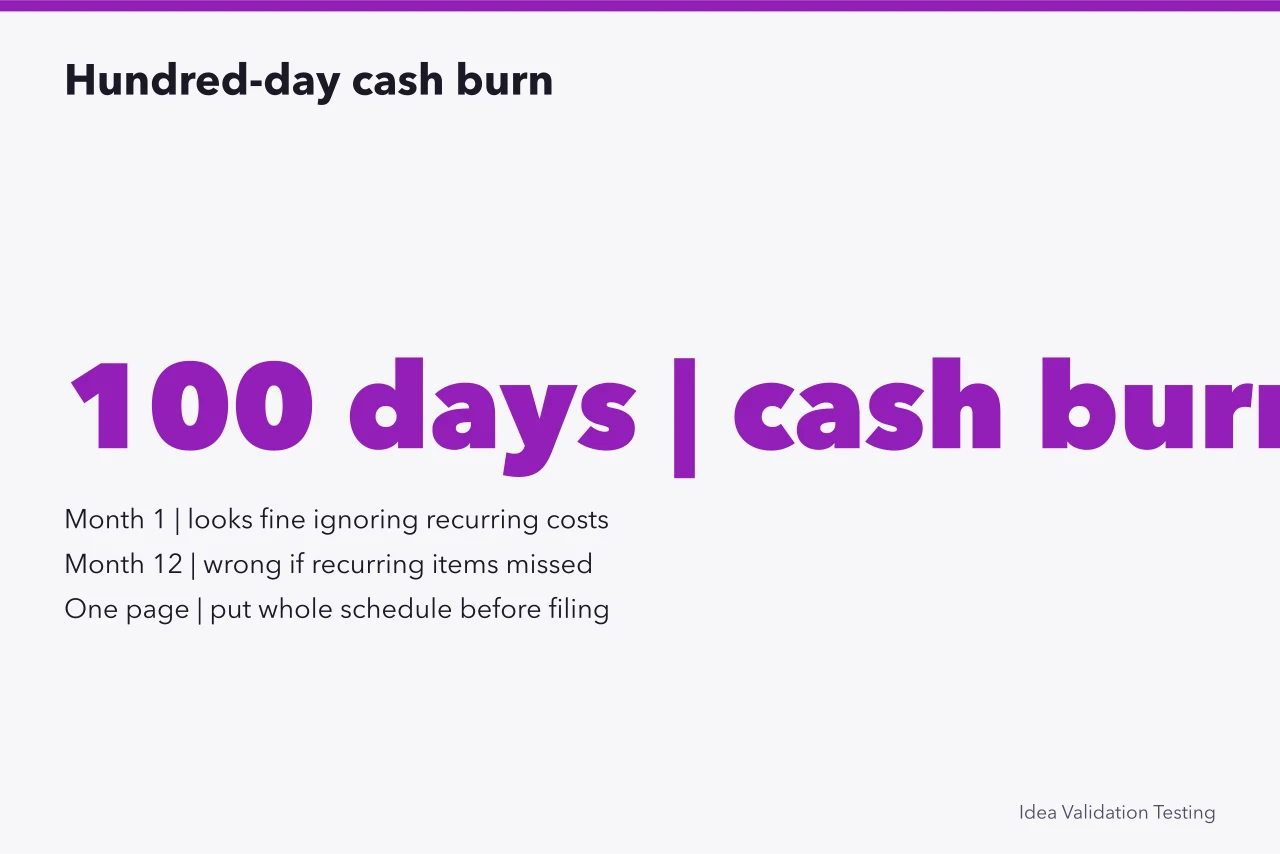
Founders often compare only the filing fee and forget the rest. A validation budget that ignores the recurring items will look fine in month one and wrong by month twelve. Put the whole hundred-day schedule on one page before you file anything.
Delaware is popular because its corporate law is predictable and its Court of Chancery handles business disputes. That reputation does not lower your costs. It means the paperwork is standard, so you can plan the sequence.
Start with the entity, the EIN and the licenses you truly need to trade legally. The sequence in LLC formation steps in order avoids rework. Add the rest when revenue appears.
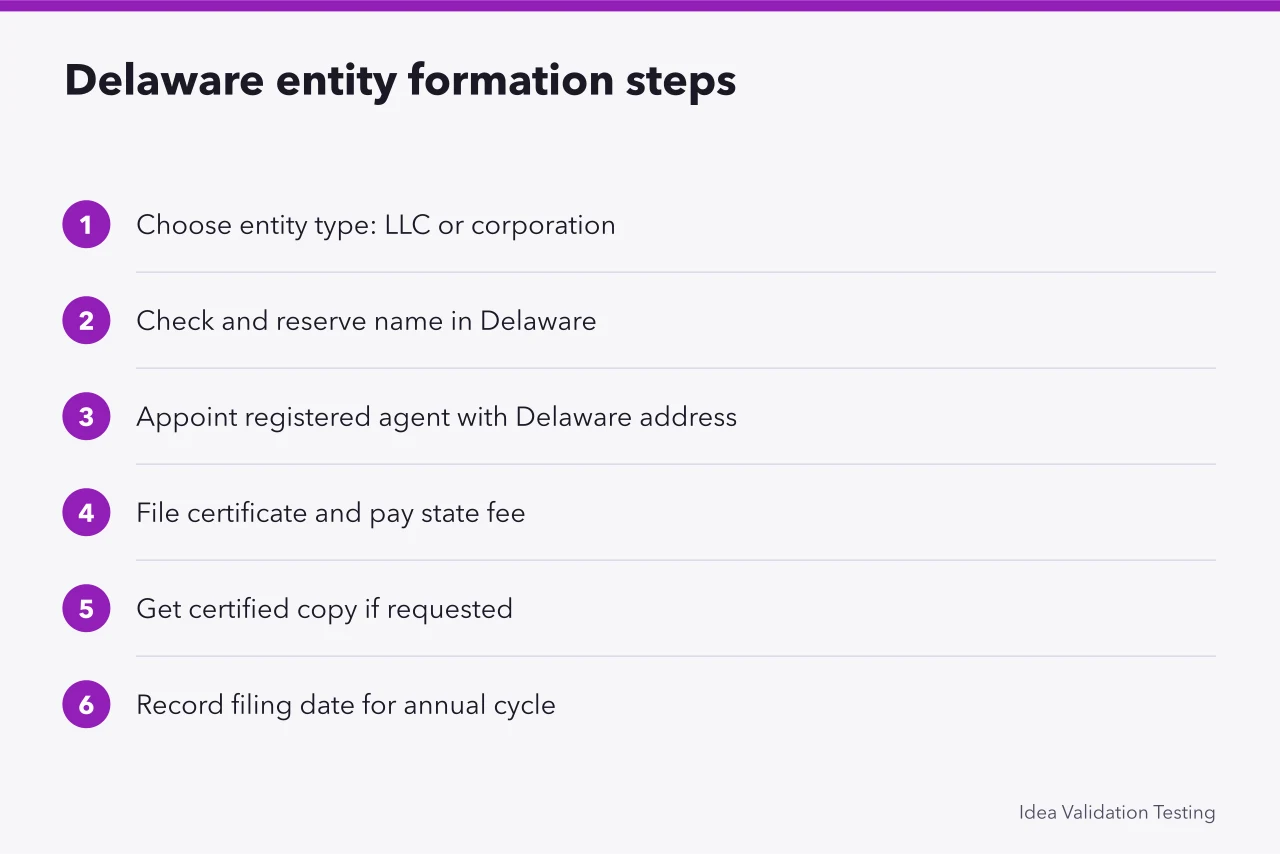
Delaware Division of Corporations registration, step by step
The Delaware Division of Corporations is the state body that creates your entity. You file a certificate of formation for an LLC or a certificate of incorporation for a corporation. The Division publishes the steps and the franchise tax basics on its how to form a new business entity page.
Delaware also offers optional expedited service for an extra fee, in tiers from next-day to one-hour handling. The Division's expedited services page lists the current amounts, which rise to $1,000 for one-hour service. If you are not in a hurry, skip it. The standard processing time is usually fine for a validation-stage company.
After the entity exists, you still need a federal EIN before you can open a bank account. That step is free and separate from the state filing. Do it the same week you form the entity.
State fees are not one number. The corporate fee schedule lists the filing fee, the certified copy charge and the expedited options, so you can price your exact case before you commit.
Choosing a registered agent and what it obliges you to do
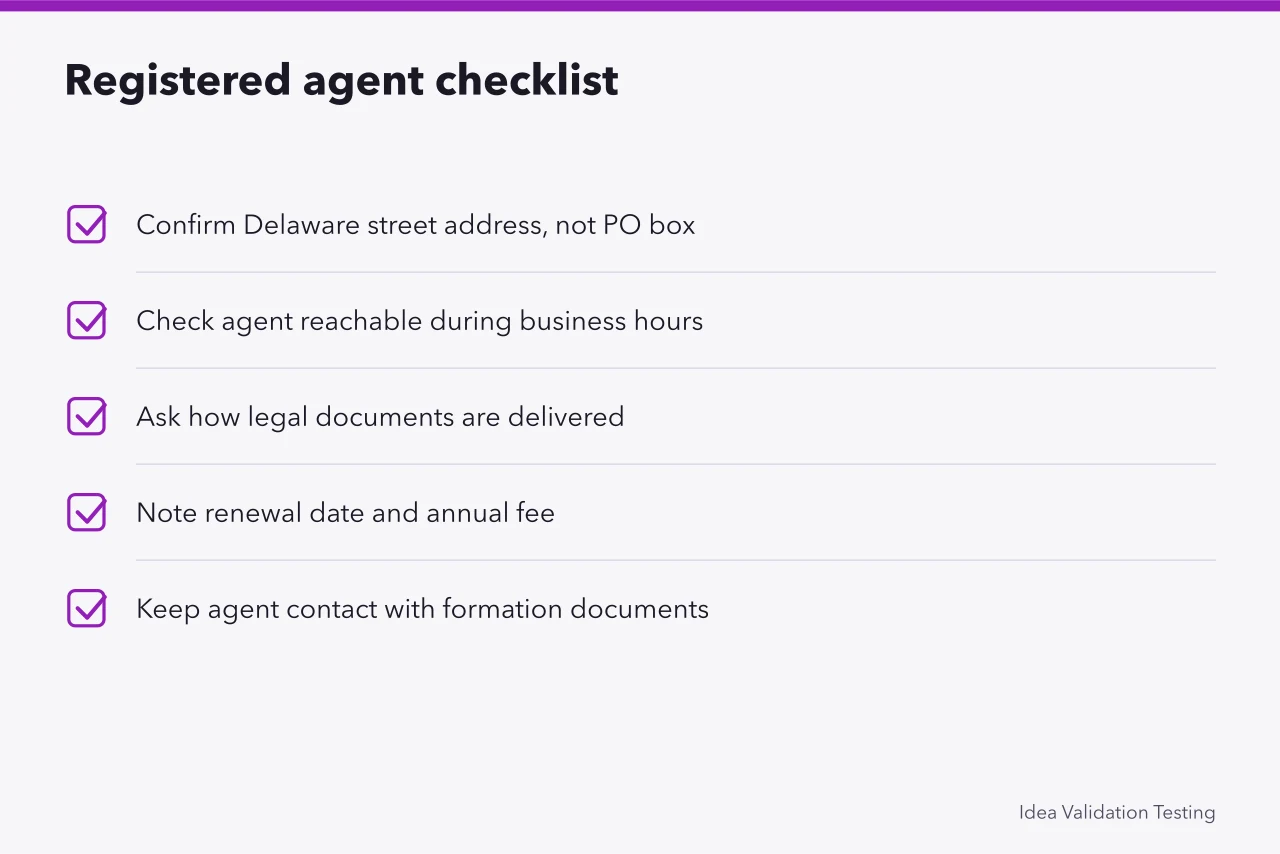
A registered agent is the person or company that receives legal papers for your entity in Delaware. The requirement is not optional. Your agent must have a physical street address in the state and be available during normal business hours.
Most founders hire a commercial agent rather than act as their own. That is usually wise if you live outside Delaware, because you need a Delaware address and someone to scan and forward documents quickly. The state keeps a list of Delaware registered agents you can use to compare providers.
The agent does more than receive mail. Service of process, state notices and tax correspondence all arrive there. If your agent is slow, you can miss a deadline and lose your good standing without noticing.
Expect a typical fee of $50 to $300 a year, often bundled with other services. Read what the bundle includes: mail forwarding, online document access and reminder emails vary by provider. A cheap agent that forwards nothing is not cheap if you miss an annual report.
One practical warning: a registered agent is not a business license. Hiring an agent does not satisfy your state licensing obligations where you actually operate.
Delaware franchise tax, annual report and quarterly estimated tax dates
Delaware franchise tax is the annual fee your entity owes the state for the privilege of being registered there. Corporations calculate it on an authorized shares method or a presumed par value capital method, with a minimum of $175 under the first and $400 under the second. LLCs pay a flat $300 annual tax instead.
Every corporation must also file a Delaware annual report, which carries a $50 filing fee for a non-exempt domestic corporation. The report updates your officers, directors and address, and it is due with the tax. The Division publishes the annual report and tax instructions you need to file correctly.
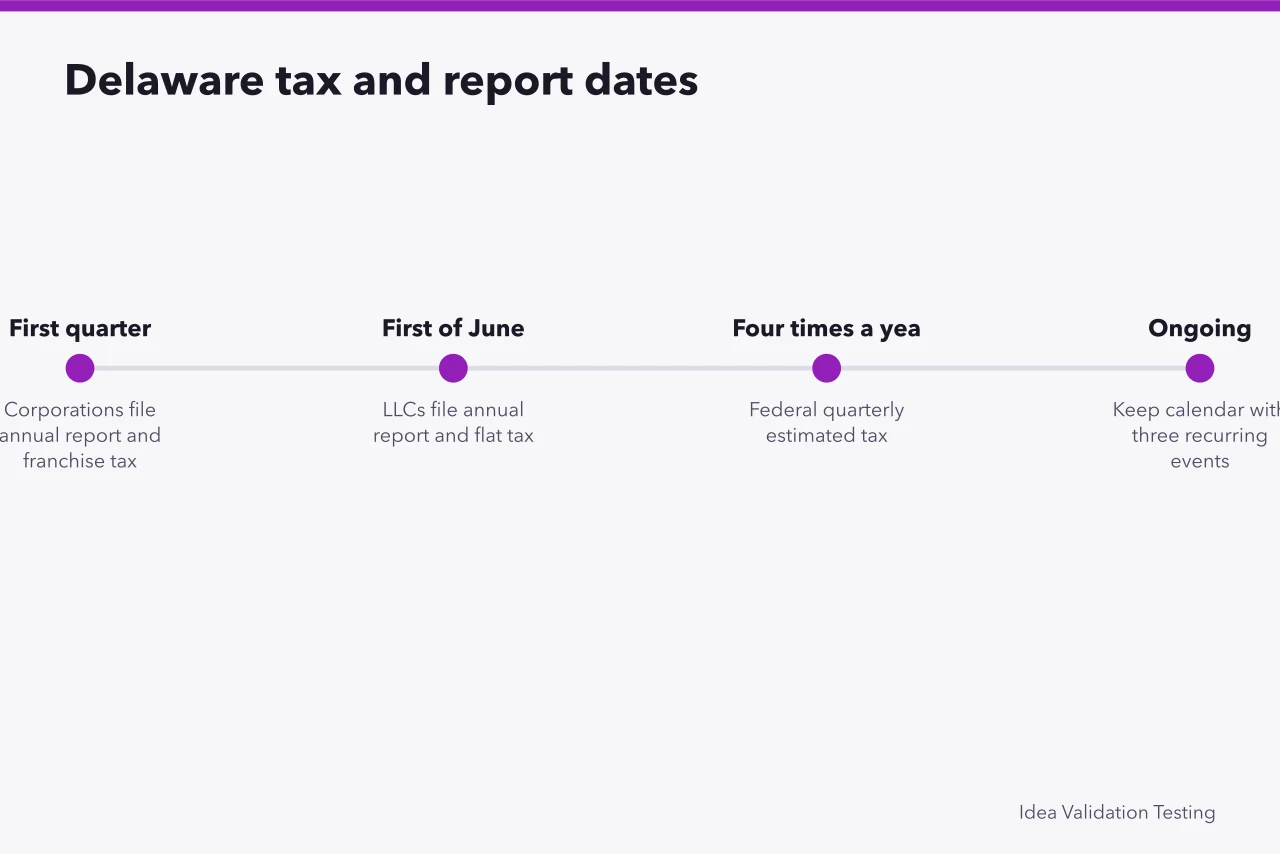
Deadlines depend on your entity type. Corporations file the annual report and franchise tax by March 1. LLCs pay the flat annual tax by June 1. Late filing triggers a $200 penalty plus interest of 1.5 percent a month.
Quarterly estimated tax is a federal matter, not a Delaware franchise tax matter. If you expect to owe federal tax, you pay it in four installments through the year. The exact dates shift, so check the current IRS schedule.
Keep a simple calendar with three recurring events: the annual report, the franchise tax and the federal estimated payments. Everything else is a one-time task.
State licensing and permit differences once you operate outside Delaware
Delaware registration does not license you to operate anywhere. Your physical location and your customers decide which state and local licenses apply. A Delaware entity selling in Texas may need a Texas permit; one serving clients in New York may need a New York registration.
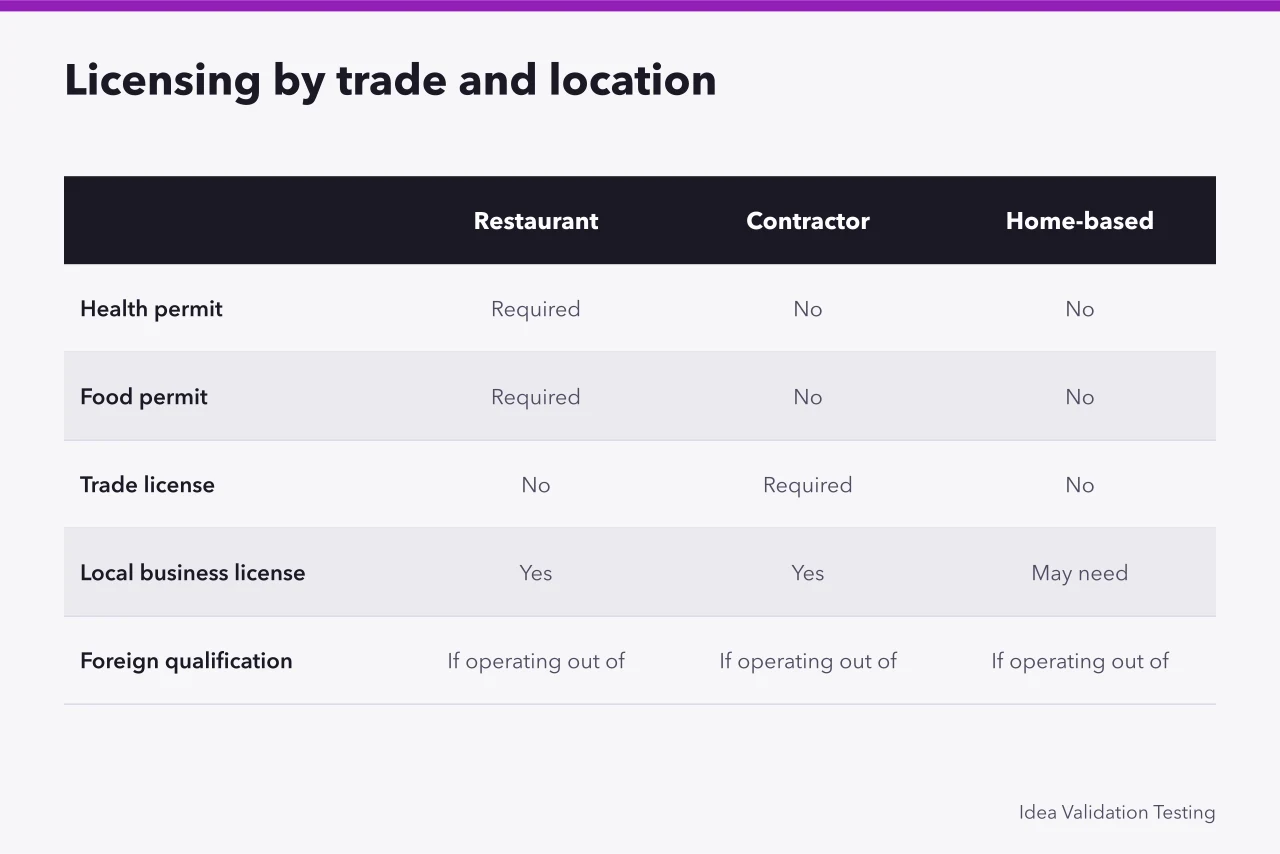
Some states require a foreign qualification when you do business there. That means registering your Delaware entity in that state, paying a fee and appointing a local registered agent. The trigger is usually a physical presence, employees or regular in-person work. The state filing guides show where the filing process differs from state to state.
Licenses vary by trade. A restaurant needs health and food permits. A contractor needs a trade license. A home-based consultant may need only a local business license. The Small Business Administration explains how federal, state and local licensing and permit obligations stack up for a new venture.
Permits also vary by city and county within a state. Zoning, signage, fire inspection and sales tax registration are common local requirements. Check the city where you operate, not just the state capital.
Use free help before you guess. SCORE offers free mentoring, and the Small Business Development Centers network provides no-cost advising in most states. Both can point you to the right licensing office for your trade and location.
- List every state where you have a physical presence.
- Check whether each one requires foreign qualification.
- Identify trade-specific licenses for your industry.
- Add city and county permits for your operating address.
- Register for sales tax where you sell taxable goods.
- Set renewal reminders for every license.
Federal steps: EIN, Schedule C and entity structure
The IRS EIN application is free and takes minutes online. You need an EIN to open a business bank account, hire employees and file most business tax returns. Apply directly through the IRS, not through a paid intermediary that charges for a free service.
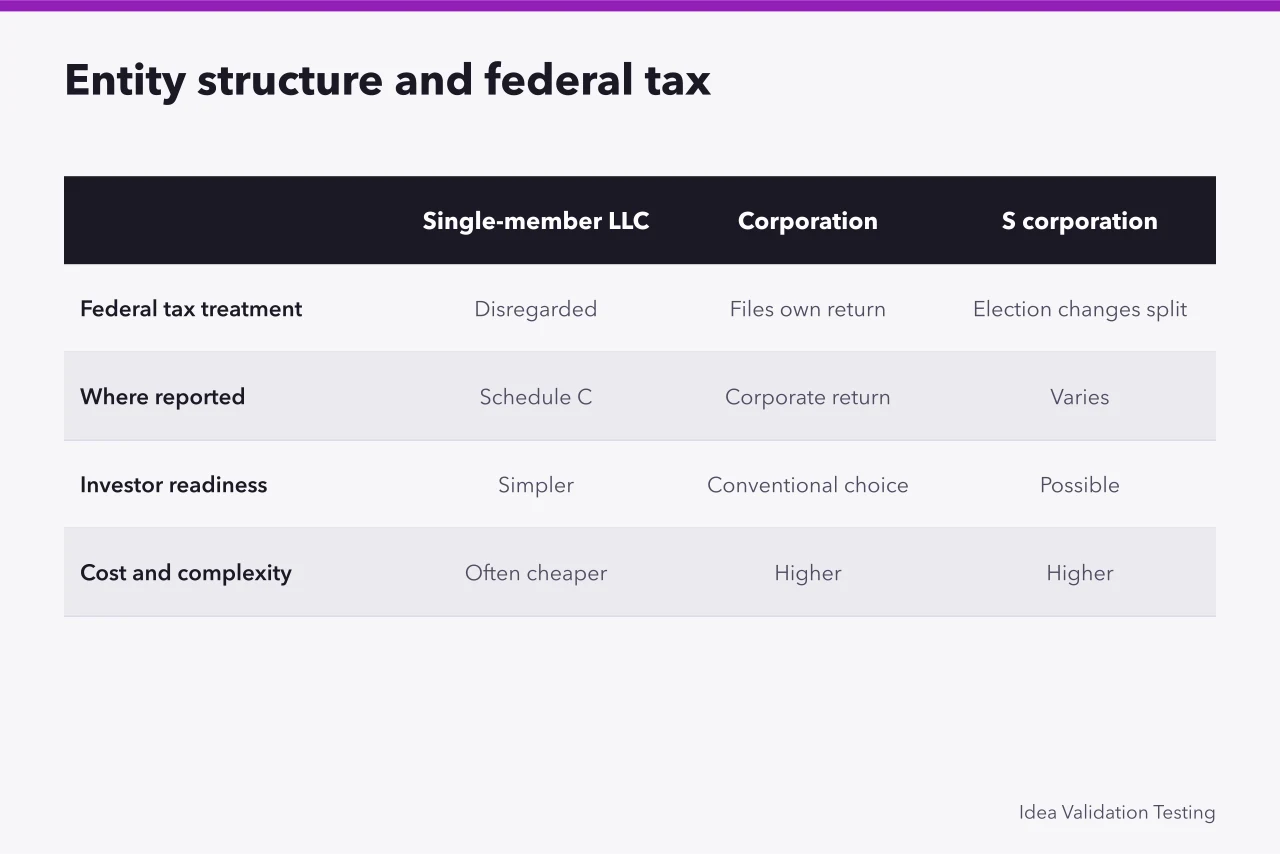
Your entity structure decides how you report tax. A single-member LLC is usually disregarded for federal tax and reports on Schedule C with your personal return. A corporation files its own return. An S corporation election changes the split again.
Schedule C is where a sole proprietor or single-member LLC lists income and expenses. It is also where your hundred-day costs become useful, because filing fees, agent fees and licenses are deductible business expenses. Keep receipts from day one.
If you plan to raise money from investors, a Delaware corporation is the conventional choice. If you are testing an idea alone, an LLC is often simpler and cheaper. Choose based on what the next hundred days require, not on a five-year fantasy.
Building the hundred-day fee schedule into a validation budget
Your validation budget should show the hundred-day cost next to the money you plan to spend testing demand. If the compliance cost dwarfs the test budget, your plan is backwards.
Start with the state fees (see what each filing actually produces), then add the agent, the licenses and the federal costs. The table below lists the hundred-day schedule with amounts and due dates.
Hundred-day fee schedule
| Item | Amount | Due |
|---|---|---|
| Delaware LLC certificate of formation | $110 | On filing |
| Delaware corporation certificate of incorporation | $89 minimum | On filing |
| Registered agent | $50 to $300 a year | On appointment |
| Delaware LLC flat annual tax | $300 | June 1 |
| Delaware corporate franchise tax | $175 minimum | March 1 |
| Federal EIN | $0 | Before the bank account |
| State and local licenses | Varies by trade | Before you trade |
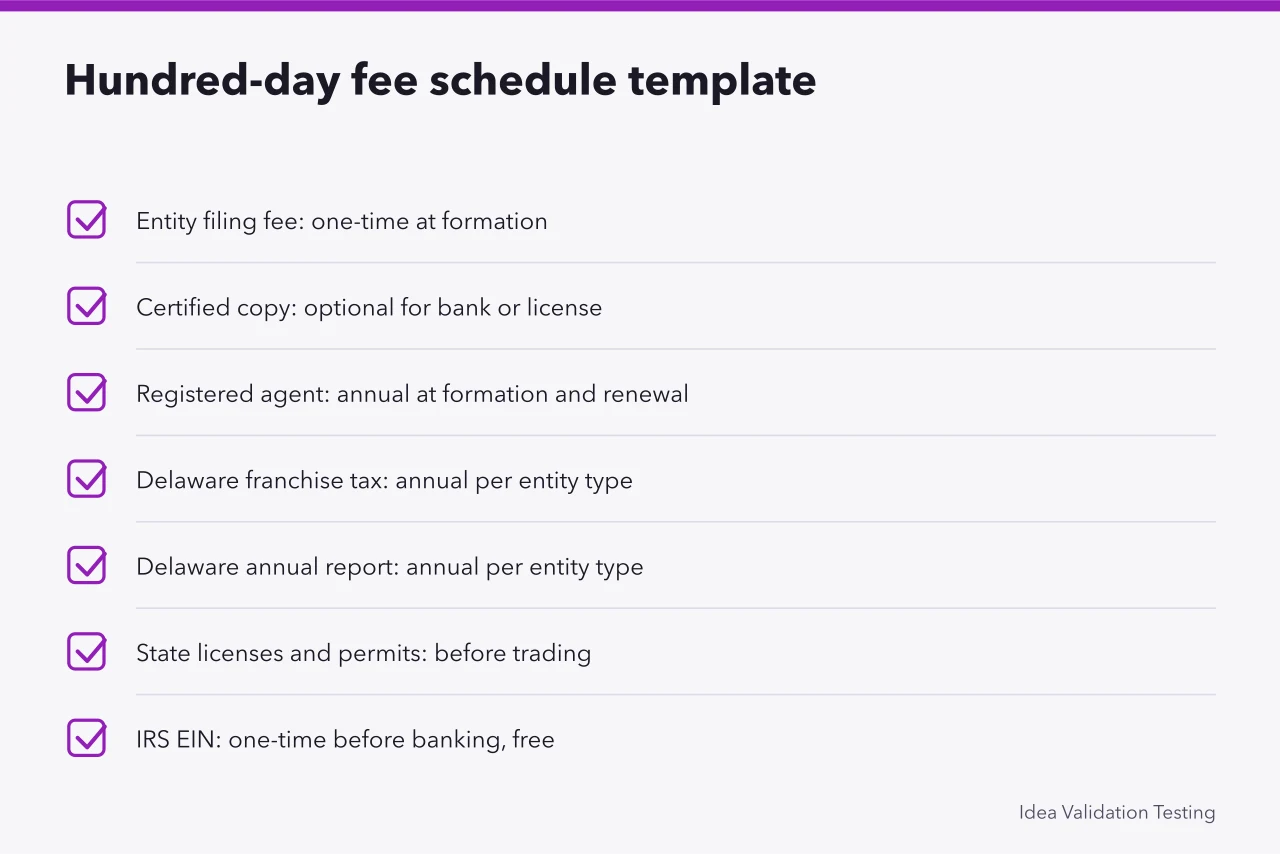
Add a contingency line. Fees change, and a license you did not expect can appear during the first hundred days. Ten to twenty percent of the compliance total is a reasonable buffer.
Two worked examples of the first-hundred-days total
The figures use the published fees above. The agent fee and the city license are illustrative.
Delaware LLC:
- Certificate of formation
- $110.
- Registered agent, mid-range
- $150.
- EIN
- $0.
- Illustrative city business license
- $75.
- Due within the first hundred days
- $335.
- Reserve for the $300 annual LLC tax, due June 1
- $300. Check the Division's instructions for when the first payment falls.
- Budget to set aside
- $635.
Delaware corporation:
A trade-specific license, such as a health permit for a restaurant or a contractor license, is added on top and varies by state and city. Ask the licensing office for its fee schedule instead of estimating.
Receipts, filing dates and license numbers need one home, so log each fee, date and document in one place.